Custom Embroidered Hat Patches: How Fashion Brands Create Unique Identity
In today’s competitive headwear market, brands need more than just good fabric and structured silhouettes—they need a signature look. Custom embroidered hat patches have become the go-to branding upgrade for fashion labels, streetwear designers, and OEM manufacturers who want to create hats with strong visual identity and market impact.
From high-end fashion collaborations to mass-production private labels, embroidered patches give hats texture, dimension, and authenticity. This article explores how custom embroidered patch hats are developed, produced, and quality-controlled inside a modern accessories factory—and why so many brands rely on them for consistent and recognizable branding.
1. Why Brands Choose Custom Embroidered Hat Patches
Whether for baseball caps, trucker hats, or limited-edition streetwear drops, embroidery instantly elevates simple headwear designs. For many fashion labels, custom embroidered hat patches offer five major advantages:
• High perceived value
Thick threads and raised embroidery add a premium, tactile finish that printed logos cannot replicate.
• Better durability for long-term use
Embroidery resists washing, UV exposure, and outdoor friction, making it ideal for sports and workwear hats.
• Strong visual recognition
Well-crafted patches help brands maintain consistent logo standards across different hat shapes and materials.
• Flexible positioning
Unlike direct embroidery, patches can be placed on curved, structured, or mesh areas with ease.
• Scalable for OEM production
Patches allow factories to mass-produce branding elements before final hat assembly.

2. Key Elements of High-Quality Custom Embroidered Hat Patches
Creating patches for premium hat brands requires precise control over materials and embroidery craftsmanship. The following factors determine the final outcome:
Thread types & texture
Factories typically offer rayon, polyester, metallic, or matte-texture threads. Polyester is the most common for custom embroidered patch hats due to its excellent colorfastness and abrasion resistance.
Embroidery density & layers
High-density embroidery (12,000–20,000 stitches) produces sharp logos and thick, luxurious textures.
Color accuracy
Brand consistency depends on accurate Pantone matching, especially for sports teams and corporate clients.
Backing options
• Heat-seal backing (for high-volume production)
• Pressure-sensitive adhesive (for temporary positioning)
• Low-melt adhesive (for technical fabrics)
• Sew-on backing (for raw denim or canvas hats)
These choices directly affect the application process during OEM hat manufacturing.
3. The Sampling Process: From Design File to Real Patch
For brands and distributors ordering custom embroidered patches for hats, sampling is the most crucial step. A typical workflow includes:
Step 1: Artwork preparation
Designers submit AI/PDF files with clear outlines, stitch details, and correct proportions.
Step 2: Digitizing
Factories convert artwork into embroidery files (DST), adjusting stitch type, angle, density, and thread colors.
Step 3: First sample production
Operators run samples on computerized embroidery machines (Barudan, Tajima, or equivalent models).
Step 4: Review & adjustments
The brand reviews thickness, borders, lettering clarity, and colors. Revisions are made until the sample is approved.
Step 5: Pre-production confirmation
Once confirmed, the factory prepares bulk threads, backing materials, and machine settings.

This structured sampling process ensures that the final hat patches perfectly match the brand’s expectations.
4. How OEM Factories Handle Large Custom Orders
Volume supply requires efficiency far beyond simple embroidery. Modern factories use:
Automated embroidery machines
Multi-head machines deliver consistent stitching, reducing human error and production time.
Laser-cutting systems
Laser technology ensures perfect patch outlines, even on complex shapes and multilayer patches.
Automated heat-press lines
For custom embroidered patch hats, factories often heat-apply the patches before final quality checks.
Barcode-based batch management
Helps track materials, order status, and color-lot consistency across thousands of units.
These technologies allow OEM manufacturers to fulfill fast-fashion and sportswear orders without compromising quality.
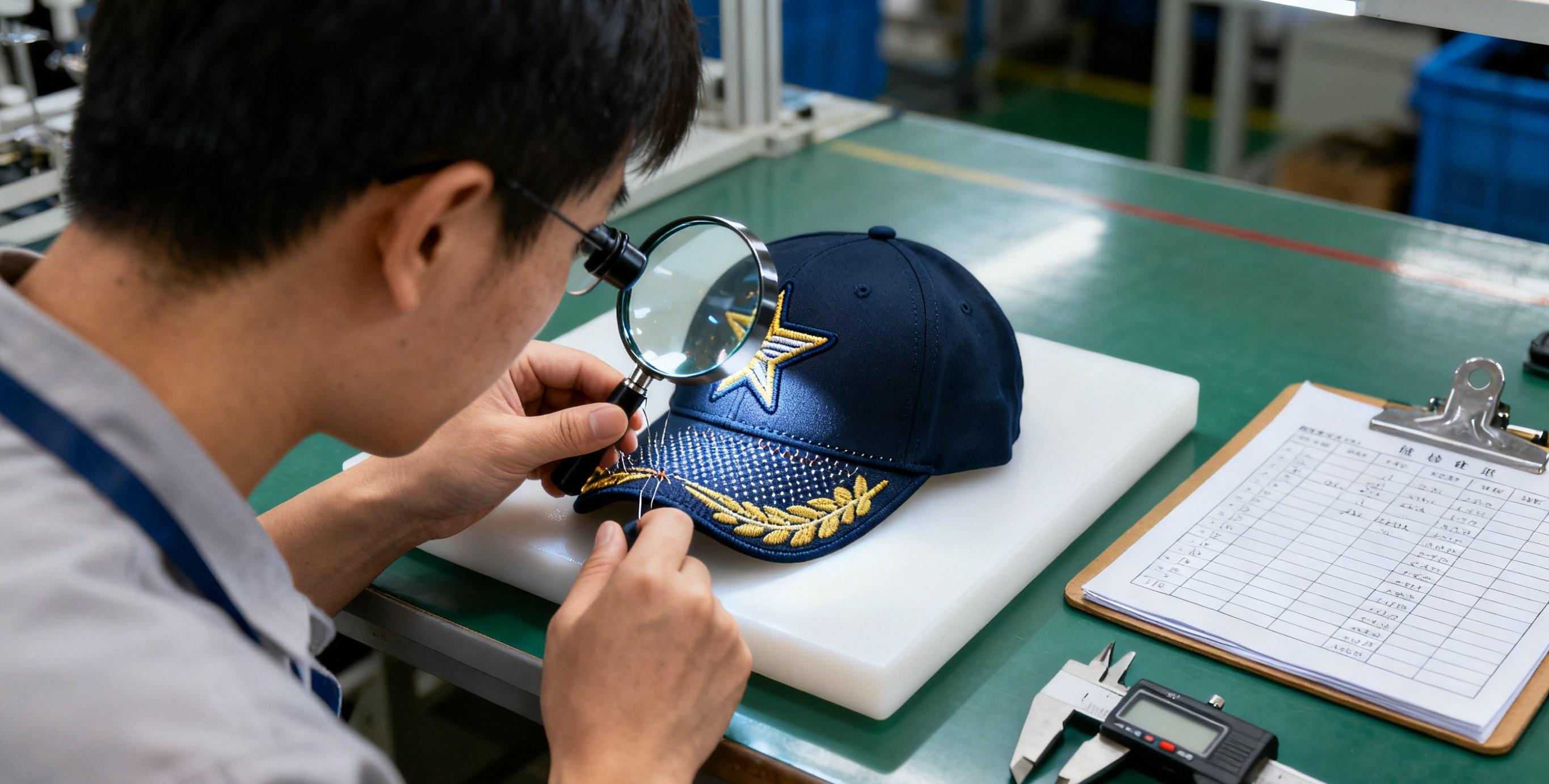
5. Quality Standards for Custom Embroidered Patches for Hats
Brands expect strict QC processes. Professional factories typically evaluate:
Stitch consistency
No loose threads, uneven edges, or distortion.
Color fastness
Tested under washing, UV exposure, and sweat conditions.
Adhesive strength
Especially for heat-seal and pressure-sensitive backings.
Shape stability
Laser-cut boundaries must remain clean and uniform.
Durability after application
Patches must remain firmly attached after 20–30 industrial wash cycles.
6. Application Scenarios for Custom Embroidered Patch Hats
Sports brands
Team logos, fan merchandise, and performance caps.
Streetwear labels
Bold, high-density patches for limited drops.
Outdoor & workwear
Durable patches built for rough environments.
Small designer brands
Low-MOQ production with premium embroidery finishes.
For deeper customization options:
? Explore our full guide to custom branding solutions for hats (internal link placeholder)
Conclusion: Build a Strong Visual Identity with Custom Embroidered Patches
As fashion brands continue to push for stronger differentiation, custom embroidered hat patches have become one of the most powerful and versatile branding tools. With advanced digitizing, laser precision, and high-volume embroidery equipment, OEM factories can now deliver patches that meet global brand expectations—even for complex, multicolor, or fine-line designs.
If you need reliable production, low MOQ options, or premium-quality patches for your next collection:
? Contact us for custom embroidered patches for hats with fast sampling and stable bulk production.
Embroidered Patch Hats in Streetwear: Trends & Production Techniques
The Complete Guide to Embroidered Hat Patches for Modern Headwear Brands